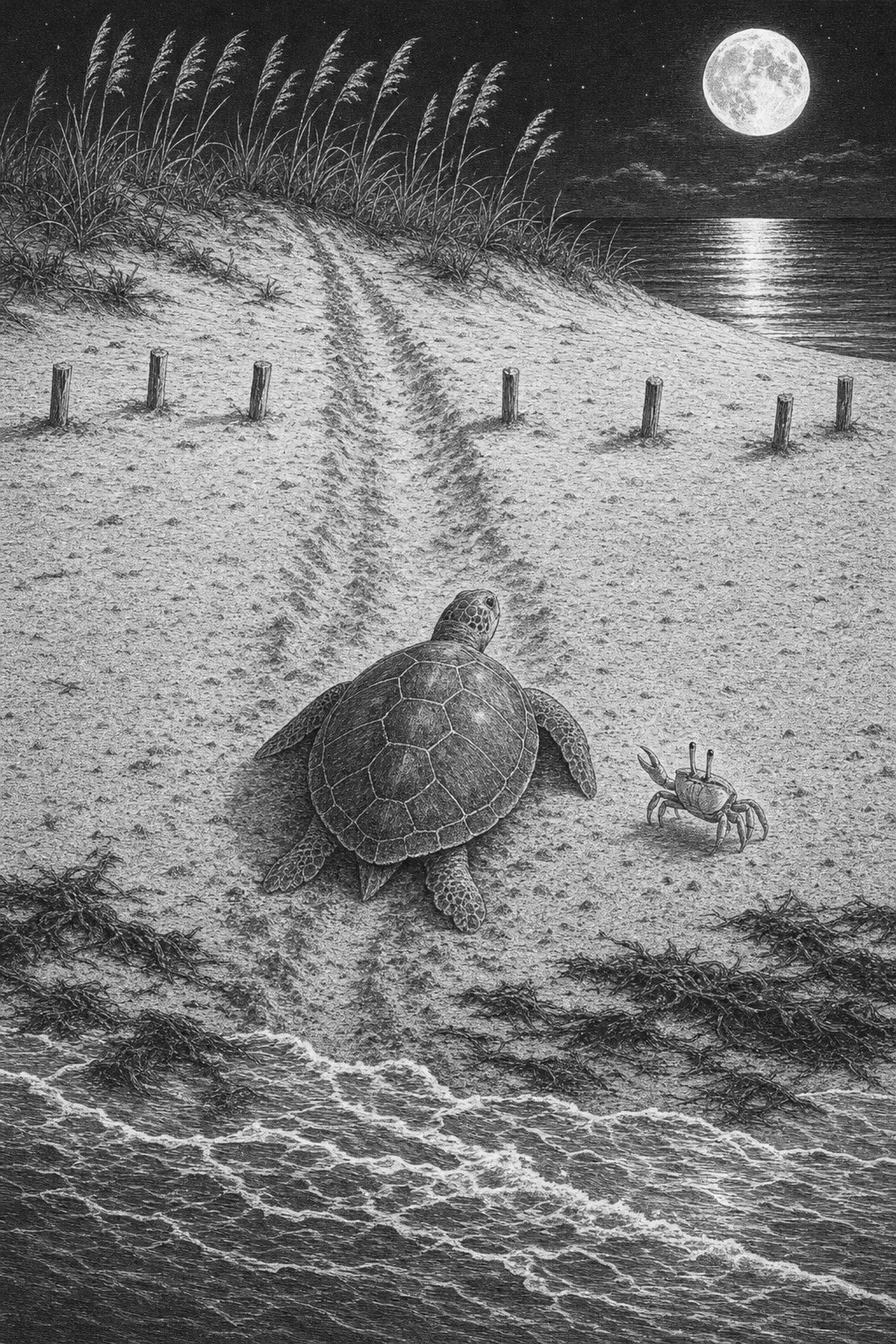
The sea stood up
Juno Beach · October 25–29, 2026
There was no hurricane. That is the first thing to say, because everyone who walked down to the beach this week asked the same question: what was that? A low sat stalled over the Bahamas. A high sat parked over the Northeast. Between them the wind blew out of the northeast for five days and would not quit, 20 to 25 miles an hour with gusts past 40, and the sea it pushed ahead of it ran 10 to 14 feet. Under all of that, the Hunter's Moon turned full just after midnight on Monday the 26th, two and a half days short of its closest pass of the month. The ocean does one thing when the moon leans in. It stands up.
At the nearest tide gauge, the Lake Worth Pier, the water on Tuesday the 27th peaked at 5.77 feet, a foot and three-quarters above what the tables promised and almost half a foot above the mark set by Hurricane Nicole in 2022. That figure is preliminary, the gauge was taking a beating, but the beach does not wait for the numbers to be verified. It went. The wooden panels on the Juno Beach Pier popped out the way they were built to, and the county closed the gate. In Carlin Park the stairs behind the Jupiter Civic Center, a bathhouse built in the early 1930s with Depression-era relief labor, fell away, and the county trucked in sand to hold the dune under a building that is nearly a hundred years old. Four of our own beach accesses closed over drop-offs and broken stairs.
Why the fall tide is the king
Every fall the biggest tides on this coast come in, September through November, and the reason is not the moon alone. The water off Florida is warmest in fall, so it takes up more room. The Gulf Stream runs slowest in fall, so it lets more water pile up against the coast. By the Lake Worth gauge's own monthly averages, the sea here sits close to a foot higher in October than it does in February, before any moon or wind gets involved. Then a full moon arrives two and a half days before perigee, the point in its orbit nearest the Earth, and you have a perigean spring tide: the kind that can run a foot or more above a spring tide with the moon at its farthest. Add five days of onshore gale. The weather service had circled October 23–31 as the highest tides of the year weeks before they came.
And the sand? It is not gone. This is the part Storm Season readers already know. Big waves cut the beach and carry the sand out to the offshore bar, where you can see them breaking far out this week on sand that was the beach a week ago. Calm-weather waves walk it back, a few grains at a time, over the winter and spring. The county pumped about 1.2 million cubic yards of sand, by its own count, onto this beach in the winter of 2020–21, from a borrow area 1.7 miles northeast of Jupiter Inlet, and the next round of Juno Beach nourishment is already on the state's funding list for this fiscal year. The beach lends. It is a slow lender, and it keeps its books.
Under the sand, when the sea cuts it open, is the old coast: the black fossil shark teeth everyone hunts, the coquina ledge that surfaces up the road at Blowing Rocks, and just off the beach at Jupiter Inlet, in ten or twelve feet of water, the wreck of the San Miguel de Archangel, a Spanish aviso that went down in a December storm in 1659 and was found by a lifeguard, Peter Leo, in July 1987. The famous 1715 fleet lies farther north. Jupiter's wreck is older.
Who climbed higher
The nesting season closes on Halloween, and the Loggerhead Marinelife Center's running count on its 8.5 miles stands at 13,870 loggerhead nests, 3,882 green, 310 leatherback and one olive ridley, which LMC says is the first ever documented nesting in Florida. The September king tide washed out several late nests; what this one took has not been counted yet. FWC's rule when you find exposed eggs: leave them. They will not have survived, and a mother lays several nests a season, so the odds are some of them make it. The hopeful detail, from LMC's own scientists: green turtles nest higher on the beach, up against the dune, and LMC believes it is an adaptation to seasonal swings in tides, weather and beach conditions.
Attached to this letter
The Turtle Who Climbed Too Far. A green turtle who nests farther up the beach than anyone thinks sensible, and what the ghost crab finds at the top of the new cliff the morning after the king tide. Three pages, plate first, signed. The full text is below, with the signed PDF and the two-page letter.
Two new ones on the shelf, and one on the way
Pip and the Pumpkin Moon — A Spooky-Fun Fable from Juno Beach. Pip is a ghost crab, not a ghost, a crab, and on the one night in October the Pumpkin Moon comes up out of the sea every sound on the beach is scary until it turns out to be a neighbor. Six sounds to shout, one brave thing to say together, a lighthouse to blink with. Written for the pumpkin patch at Holy Spirit Lutheran. Ages 3 to 8. Kindle $4.99 · Paperback $14.99
The Boat Called Caesar — The Salt Kingdom, Book Two. Nassau, 1718. The King has pardoned every pirate on the water, and every account is cleared except the ones written in people. A boat with no colors crosses the reef at night for one name. A complete story; begins three years after The Coast of Teeth and reads on its own. Kindle $6.99 · Paperback $16.99
The Widow's Walk — The Salt Kingdom, Book Three. Harbour Island, 1722. Every evening she climbs to the roof and watches for a ship that is not coming home. The sea did not take it. A signature did. Then the summer of 1733, a hurricane drowns the Spanish fleet on the Florida Keys, and a name called Caesar goes on trial. Coming in November. Tide Letter readers get the link first. The Widow's Walk
One ask this month: if you read Caesar, an honest review on Amazon is the thing that finds it its next reader.
The Storm Season
If you want the whole weather in fables, The Storm Season is the book for this week: the sea oats and the gale, the mangrove and the seawall, the shore the storm left. It is the one written for the months when the sand rearranges itself overnight. Kindle and paperback on Amazon, and on Spotify read by Grandpa Spuds. Kindle · Paperback · Spotify
Look ahead
The next king tides are forecast for November 5–10 around the new moon, and the Beaver Moon on November 24 is a true supermoon. The pier reopens when the county and LMC finish reattaching panels and inspecting the rail. The beach will be wide again by nesting season. It always is.
Thank you for coming down to meet the tide. Happy Thanksgiving from the Golden Shore.
John M. Henry
Juno Beach, Florida
P.S. Off the list anytime. Reply UNSUBSCRIBE. No hard feelings. The tide keeps coming either way.