Skip to content
Archive · October 2026

The Tide Letter

All three, out loud — the Salt Kingdom sets sail — and two fables: one for the Hunter's Moon, one for the morning the sky grew a jellyfish.

Archive · October 2026

All three, out loud

The fables were written to be read aloud, so now they are. The Golden Shore, The Storm Season and The Nesting Moon are on Spotify as audiobooks, narrated by Grandpa Spuds Oxley, a digital voice with a porch-swing cadence. A fable every three minutes. Included with Spotify Premium in the US.

The shelf is full

Ninety-three fables in three books, Kindle and paperback, on Amazon: a golden morning, a storm season, and a nesting moon. One fable, one night, is still plenty. All three on Amazon.

Soft launch · The Salt Kingdom, Book I: The Coast of Teeth

“The treasure fleet is drowned. The gold is the least of it. Someone wrote everything down.”

The soft launch is here, and Tide Letter readers hear it first: the Salt Kingdom sets sail with The Coast of Teeth. Florida, 1715: the hurricane, the false channel, and the coast that keeps better books than any empire, built on the true wrecks of the 1715 Treasure Fleet. If you walk Juno Beach after a storm, you already know the setting. It is not a bedtime book. It is the one for after they are asleep. And this is only Book I. Four more Salt Kingdom books are coming, one day soon, on the winds.

One ask this month: if you read it, leave an honest review on Amazon. For a new novel it is the single thing that helps it find its next reader. Kindle · Paperback

Attached to this letter

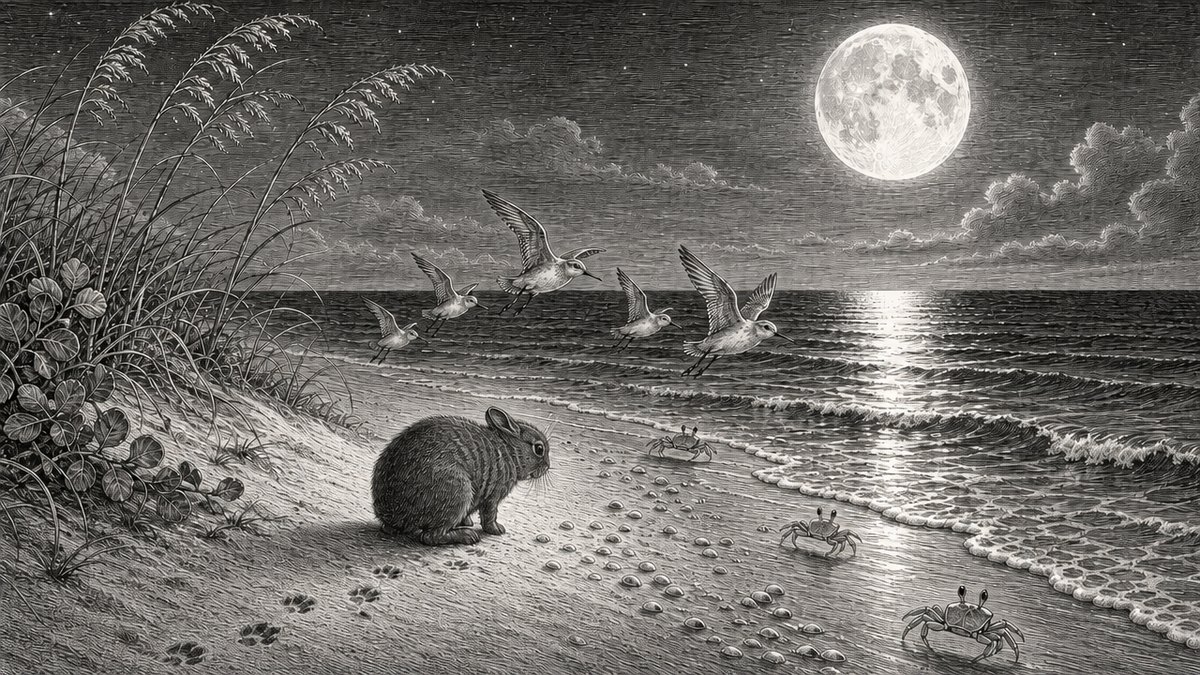
The Marsh Rabbits and the Hunter's Moon. A small marsh rabbit is certain the whole beach is hunting her — until she walks down to the water and finds out who is afraid of whom. Two pages, plate first, signed. Print it and read it aloud on Sunday night, October 25, when the Hunter's Moon comes up out of the Atlantic. Download the signed PDF.

Thank you for coming down to meet the tide.

John M. Henry
Juno Beach, Florida

P.S. Off the list anytime. Reply UNSUBSCRIBE. No hard feelings. The tide keeps coming either way.


Tide Letter fable · October 2026

The Marsh Rabbits and the Hunter's Moon

A fable from the Golden Shore · Juno Beach, Florida

Pen-and-ink plate: a small marsh rabbit on the moonlit beach at Juno, ghost crabs scattering, the Hunter's Moon rising over the Atlantic

Behind the dunes at Juno Beach, where the sea grape leans away from the wind and the rainwater sits in low places and will not leave, there lived a family of marsh rabbits.

They were not the rabbits of storybooks. They were small and dark and sturdy, with short ears and none of that white cotton on the tail that the cottontails up the road were so proud of. They did not bound across open meadows, because there were no open meadows and bounding is a good way to get eaten. They walked, one foot and then the other, like cats, through tunnels of palmetto they had cut for themselves. And they came out only at night.

The youngest of the litter was a doe called Pennywort, after the plant her mother liked best, and Pennywort was afraid of everything.

She was afraid of the Great Horned Owl, who asked the same question all night long and never waited for the answer. She was afraid of the bobcat's shadow, which she had never seen but could describe exactly. She was afraid of the red-tailed hawk by day and the coyote by dusk and the black racer in the grass at noon, and she was afraid of the two white eyes that roared past on the road at the top of the dune, and most of all she was afraid of the moon.

“October,” said her grandmother, “is when the big moon comes. The Hunter's Moon. On that night the beach is lit like noon, and the owl can see a whisker move from the top of the tallest pine. On that night you stay in the palmetto. Everybody does.”

Pennywort stayed. She stayed through the first thin moon and the half moon and the fat lopsided one. But on the night the moon came up out of the Atlantic full and orange and enormous, the way it does in October, something in her grew very tired.

“What is the use of a life,” she said to her brothers, “where everything in the world is looking for you? Owls above and snakes below and lights on the road. I am the smallest thing on this whole coast. I am nothing but dinner with ears.”

Her brothers, who were busy eating, said nothing useful.

So Pennywort did the one thing she had never done. She went up the dune. Not away from the moon but toward it. If she was going to be afraid for the rest of her life, she decided, she might as well see what she was afraid of.

The sea oats closed over her, and then opened, and there it was: the whole Atlantic, silver to the edge of the world, with a road of light laid down the middle of it straight to her feet. The beach was bright as noon, just as her grandmother said. There was nowhere to hide. Her heart went like a drum.

She walked down anyway, one foot and then the other, to the wet sand where the last wave had been.

And the beach exploded.

Ghost crabs — a dozen of them, pale as the sand, out doing their nighttime business — saw her coming and went sideways in every direction at once, up on their tiptoes, eyestalks high, diving into their holes with their claws over their heads. A flock of sanderlings, who had just flown in from the top of the world and had been asleep on one leg apiece, lifted off in a single terrified sheet and complained about it all the way down the beach. The coquinas at the tide line felt her shadow and dug themselves straight down, a hundred little clams vanishing into the sand like a hundred little sunsets, in a hurry.

Pennywort stood in the moonlight on the empty wet sand and looked at where everybody had been.

“They ran,” she said. “From me.”

She looked down at herself — the short ears, the plain brown tail, the small cat-footed feet that had never bounded anywhere — and she tried to see what the crabs had seen. Something huge. Something that came down the dune out of the dark without any warning, with a shadow that blotted out the moon.

A ghost crab put one eye up out of his hole, then the other, and considered her.

“Are you going to eat us?” he asked.

“I eat pennywort,” she said. “And cattails. And the tops of the sea oats when nobody is looking.”

“Well, you might have said so,” said the crab, and he came up a little further, and the sanderlings landed again further down, pretending they had meant to leave all along.

Pennywort sat on the wet sand a while and watched the moon ride up. The owl was out there somewhere, asking his question. The bobcat's shadow was out there, somewhere, being exactly the shape she had always imagined. None of that had changed. But something had.

When she went back up the dune she went carefully, and when she passed the coquinas she went around.

Moral: Everybody on the beach is afraid of something — and something on the beach is afraid of you. Carry both, and walk gently.

Signed PDF · The Marsh Rabbits and the Hunter's Moon


Between the tides · October 13, 2026

The morning the sky grew a jellyfish

At 6:33 on the morning of October 13, a SpaceX Falcon 9 lifted off from Cape Canaveral carrying NASA's CRS-35 cargo run to the Space Station. From our beach it came up past the end of the pier, climbed, and bent away over the ocean. A few minutes later the sky grew a jellyfish. Half of Florida was awake and asking what it was. So I wrote it down the way my grandfather would have told it. As a fable. This one is not a monthly letter — the Tide Letter still comes about once a month — just a gift for everyone who looked up.

What you saw: the rocket's exhaust, mostly water vapor, frozen high in air so thin it spreads out wide, lit by a sun that was already up at that altitude while we were still in the dark. It only looked like it was falling. It was following the curve of the Earth. Launches around an hour before sunrise are the ones that do this.

Tide Letter fable · October 13, 2026

The Ghost Crab and the Sky Jelly

A fable from the Golden Shore · Juno Beach, Florida

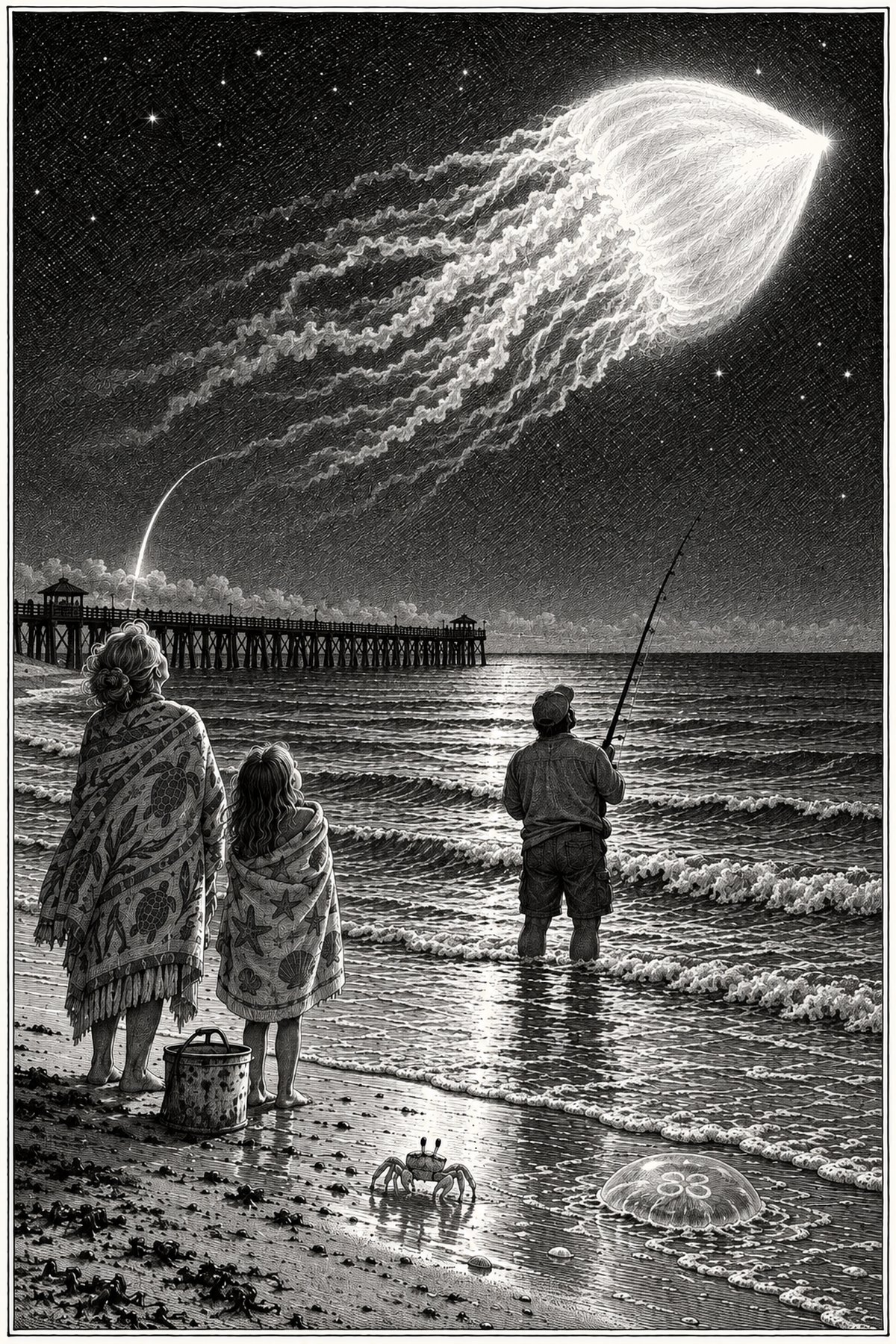
Pen-and-ink plate: a grandmother, a girl and a surf fisherman on Juno Beach before dawn, the pier to the left, a glowing jellyfish-shaped rocket plume over the ocean, a ghost crab and a moon jelly at the water's edge

Before the sun comes to Juno Beach, the beach belongs to the Ghost Crab.

He is the color of the sand on purpose. He has eight legs for running sideways, two claws, and two eyes on stalks that turn every which way, so that nothing on the beach happens without his seeing it. He is very proud of those eyes. All night he runs the wrack line, and by morning he can tell you everything that washed up and what each thing is: a sea bean, a shark's tooth no bigger than a fingernail, a sand dollar, somebody's left flip-flop. The Ghost Crab knows the name of everything. That is his whole job, and he is good at it.

On this particular morning, in the thin dark before dawn, on the stretch of beach just south of the pier, a Moon Jelly had drifted in on the tide and lay rocking in the wash, pale and round as a dropped coin, with a four-leaf clover showing through her glass. To the north the pier jutted long and dark into the sea, its lights off, like a black comb somebody had laid on the water.

“Crab,” said the Moon Jelly, “what does the morning look like?”

“Gray,” said the Ghost Crab, without turning a stalk. “Same as yesterday.”

A Moon Jelly has no eyes, only little light-spots around her rim. She can feel the light growing, the way you feel the sun on your arm with your eyes shut, but she cannot see a shape. So she had to ask. She was used to asking.

Down the beach a Fisherman stood knee-deep in the trough with a bucket of sand fleas and a long rod, casting into the dark with the pier off his left shoulder. Beside him on the dry sand stood a Girl and her Grandmother, visitors, wrapped in beach towels against the cool. The Girl came from a city where the sky was a strip between the buildings. She had never seen so much of it at once.

“What time is it?” the Girl asked.

“Six thirty-two,” said the Fisherman, who had not looked at a watch. “Watch past the end of the pier. In a minute there'll be a rocket.”

“How do you know?”

“Been standing here thirty years,” he said, and cast again.

At six thirty-three, a star climbed out of the sea.

It came up orange beyond the end of the pier, beyond the lighthouse, beyond everything, too far away to hear, and it climbed and climbed and bent slowly away to the northeast, out over the water. The Girl's mouth fell open. The Grandmother's hand found the Girl's shoulder. The Fisherman reeled in.

And then it happened. High up, higher than any bird or cloud, the rocket's breath climbed into sunlight. The sun was not up yet on Juno Beach. Not for most of an hour. But up there, where the rocket was, the morning had already arrived, and it reached down and lit the rocket's long trail of frozen breath until it glowed. The trail swelled. It bloomed. It grew a shining bell as wide as the sky and let down long, pale tentacles behind it, blue and silver and white, with a smudge of orange underneath like the last of a sunset. It swam, enormous and silent, across the dark.

“A JELLY!” cried the Ghost Crab, every leg off the sand at once. “A jelly swimming the sky! Your cousin, Moon Jelly. Your cousin is in the sky!”

“Tell me,” said the Moon Jelly.

So the Crab told her. He told her about the bell and the light inside it. He told her about the tentacles trailing back toward the sea. He told her the colors, one by one. Now, a Ghost Crab can see all the way around himself, but he cannot see straight up. There is a hole in the top of his looking, and he never thinks about it. But the sky jelly was not straight up. It was low over the ocean, out past the pier, in the one strip of sky a Ghost Crab can see, and he saw every bit of it. And the Moon Jelly, who had never seen anything in her life, rocked in the wash and saw it too.

“What IS it?” the Girl asked the Fisherman.

“Rocket exhaust,” he said. “Mostly water. It freezes up there, and the air's so thin it spreads out wide, and the sun's already up where the rocket is, so it lights up like a lantern. It isn't falling, either. It only looks like it's falling. It's following the curve of the world.”

The Girl thought about this. “So it's a jellyfish made of morning,” she said. “Before the morning gets here.”

The Fisherman opened his mouth to say no, it's exhaust. He had seen a hundred of these. He knew the times and the names and the pads they came from, and he had not tipped his head back for a single one in years.

He tipped his head back now. The rod hung in his hand, and the sand fleas went about their business in the bucket, and for the first time in a long time, the Fisherman looked.

By the time the real sun came up over the water, the sky jelly had thinned to a smudge and drifted off to the east. The Moon Jelly went out on the tide. The Ghost Crab went down his hole for the day, and if you had asked him what he saw that morning, he would have told you the name of everything. And then, for once, he would have stopped naming, and just told you about the jelly.
Moral: Learn the name of a wonder. Then look up anyway.

Signed PDF · The Ghost Crab and the Sky Jelly